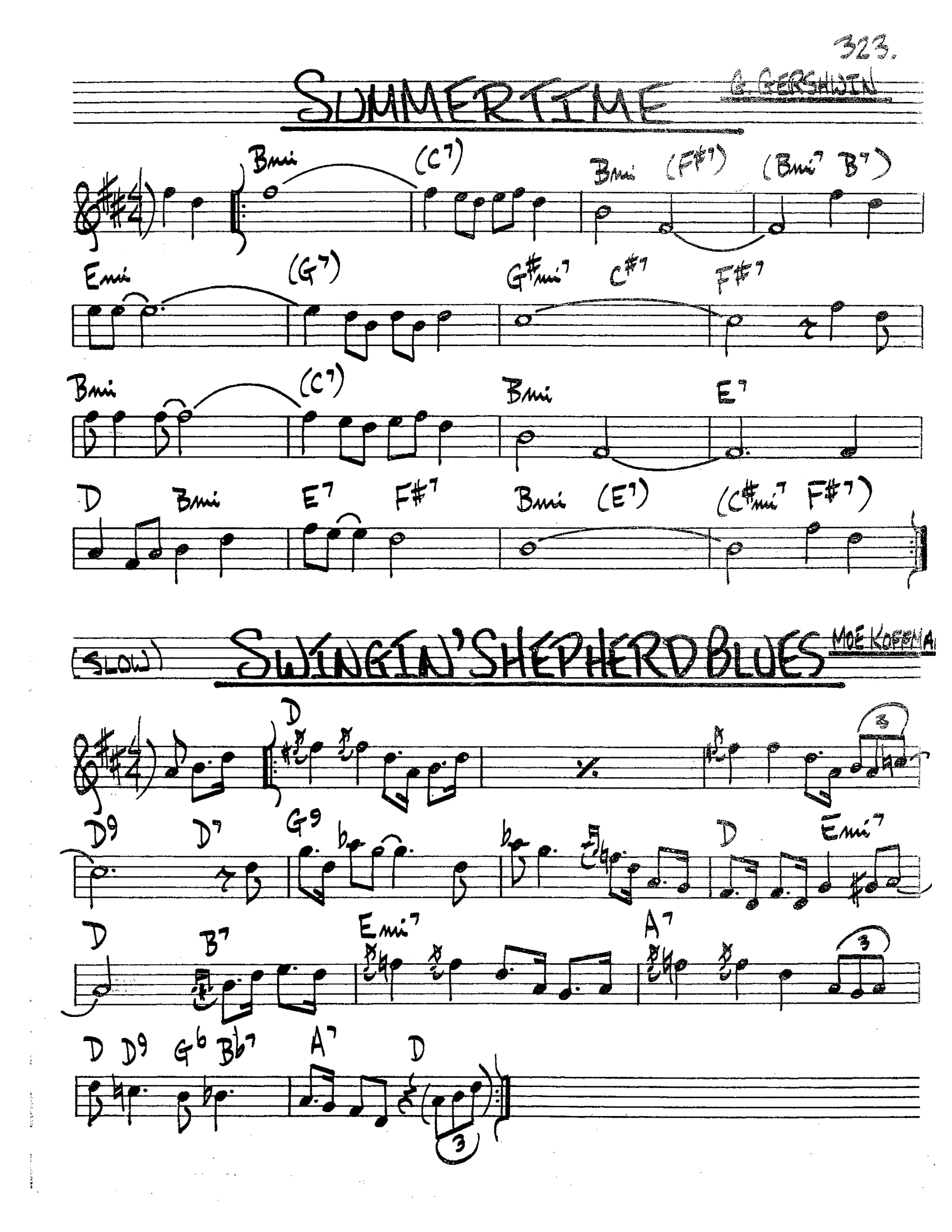
Summertime is one of the most popular jazz tunes at jam sessions and on pick-up gigs. It’s also one of the most fun jazz tunes to play on guitar. Because of this, Summertime is an essential tune to have under your fingers. While is a popular and fun jazz standard, it’s often hard to know where to start. To help you get your hands and ears around Summertime, here’s the melody and a few soloing concepts to explore.
These concepts will help you navigate the chord changes of Summertime with confidence. Learning the melody ensures you always know where you are in the tune and enables you to quote the melody in your solos when inspiration strikes.

Summertime is a fun song, but it’s harder to play than it looks, so studying this material builds your confidence and skill set to navigate this jazz standard.
Summertime (leichte Stufe, Tenorsax, Fitzgerald) (ella Fitzgerald)
Here are the tabs and notation for this easy arrangement of the Summertime theme, where I combine the melody with simple jazz chord voicings.
There are 2 guitar scales that can be used over the entire chord changes of Summertime, the A natural minor scale and the A minor blues scale.
The first is the A natural minor scale (aka A Aeolian scale). This scale has the same notes as the C major scale.
Summertime Jazz Duet Sheet Music For Clarinet In B Flat (woodwind Duet)
You can get by using only these 2 scales in your improvisation, but your solos will sound repetitive and not very interesting. One way to spice things up a bit is to add some other scales, especially over the dominant chords…
The harmonic minor scale can also be played over the ii Vs in A minor, but here we have to use the A harmonic minor scale:
Another way to add interest to your solos is using arpeggios. While explaining how arpeggios work is beyond the scope of this lesson, here’s one example you can use over the ii V in D minor in the 4th bar.
Summertime Bb Free Pdf Download
When playing over minor chords, play a maj7 arpeggio starting on the 3rd of that minor chord to get a 9 sound.
Bar 40: here I play the E altered scale, with a chromatic note in between (click here to learn how to use the altered scale).Summertime is a big one. Most would agree that it is, in fact, one of the all-time greatest standards in history. A timeless tune, Summertime has been played and recorded in a wide array of settings over the course of several decades. It was originally composed by George Gershwin with lyrics by DuBose Heyward in 1935 for the American folk opera,
Summertime is a very deep and meaningful piece of music, and I often perform it in cocktail situations. It also works very nicely with a backbeat on drums.

Summertime Backing Track And Free Chord Chart
This tune is often called by singers at jam sessions, which means you should be ready to tackle it in any key to accommodate the singer.
Therefore, I would suggest practicing this tune in all 12 keys! It's worth the effort and it will prepare you for addressing the same issue for other tunes.
For Summertime, this is actually not all that difficult. If you are somewhat familiar with jazz harmony, you will notice that the two main focal points of the tune are Dm and Gm. Toward the end of the tune, there's an F major chord, which is, in fact, the relative major.
Gershwin G Arr Rivello D Summertime Jazz Ensemble 369567
Therefore, in very general terms, the tune starts out over the i minor, then it goes to the iv minor, then it briefly goes to the relative major before returning home. I would suggest not learning this chord by chord, but think about it 4-8 bars at a time and always have the melody in your head.
Note - This tune is dissected in ourFREE 7-Day Beginning Chord Melody course. I *highly* recommend this if you want to play Summertime like a real jazzer!

Here, you have a few simple voicings that you can use for comping over Summertime. Always play around with the space the melody gives you, and if you are comping with the melody, it might be a good idea to play with longer values to give the melody room to breathe.
Amazon.de:summertime Jazz Reference
For the most part, we are simply making use of shell voicingsand drop 2 voicings. There are a few exceptions but these are the main tools here. These voicings are typically the first voicings a jazz guitar player learns, so we are putting them to work right away here.
Here, we are applying a 6/8 type of feel to the chord melody. This tune lends itself to a lot of different interpretations.
You also may have noticed that I use Eb7 and the Em7b5-A7 progression interchangeably. This is a stylistic consideration for you. They both serve as dominant functions so it's up to you and the context in which you are playing!
Jazz Standard Repertoire
In this solo, we are focusing on thematic development, as always. We are also making sure to hit those changes by targeting guide-tones on strong beats.

In addition to all of this great content, we have also provided you with a reference sheet full of some basic chord shapes you can use over this tune!
Miles Davis'Porgy and Bessalbum recorded in 1958. It features a brilliant orchestral arrangement of this tune by Gil Evans. Definitely in my top 50 jazz albums of all time!
Gershwin, George: Summertime: For Jazz Ensemble
Ella Fitzgerald & Louis Armstrong'sBest of album. The copies of the original recorded in 1957 are sometimes difficult to find and this album is more readily available. Their version is very moody, beginning with a wonderful interpretation of the melody on trumpet followed by the two of them singing. Highly recommended!
Album recorded in 1960 and released in 1961. Although only four tracks, this album is absolutely killing, particularly his version of Summertime.
Joe Pass'Complete Catch Me Sessions album is a must-have for any jazz guitar enthusiast. This album features a nice medium swing take on this classic tune.

0 Comments
Posting Komentar